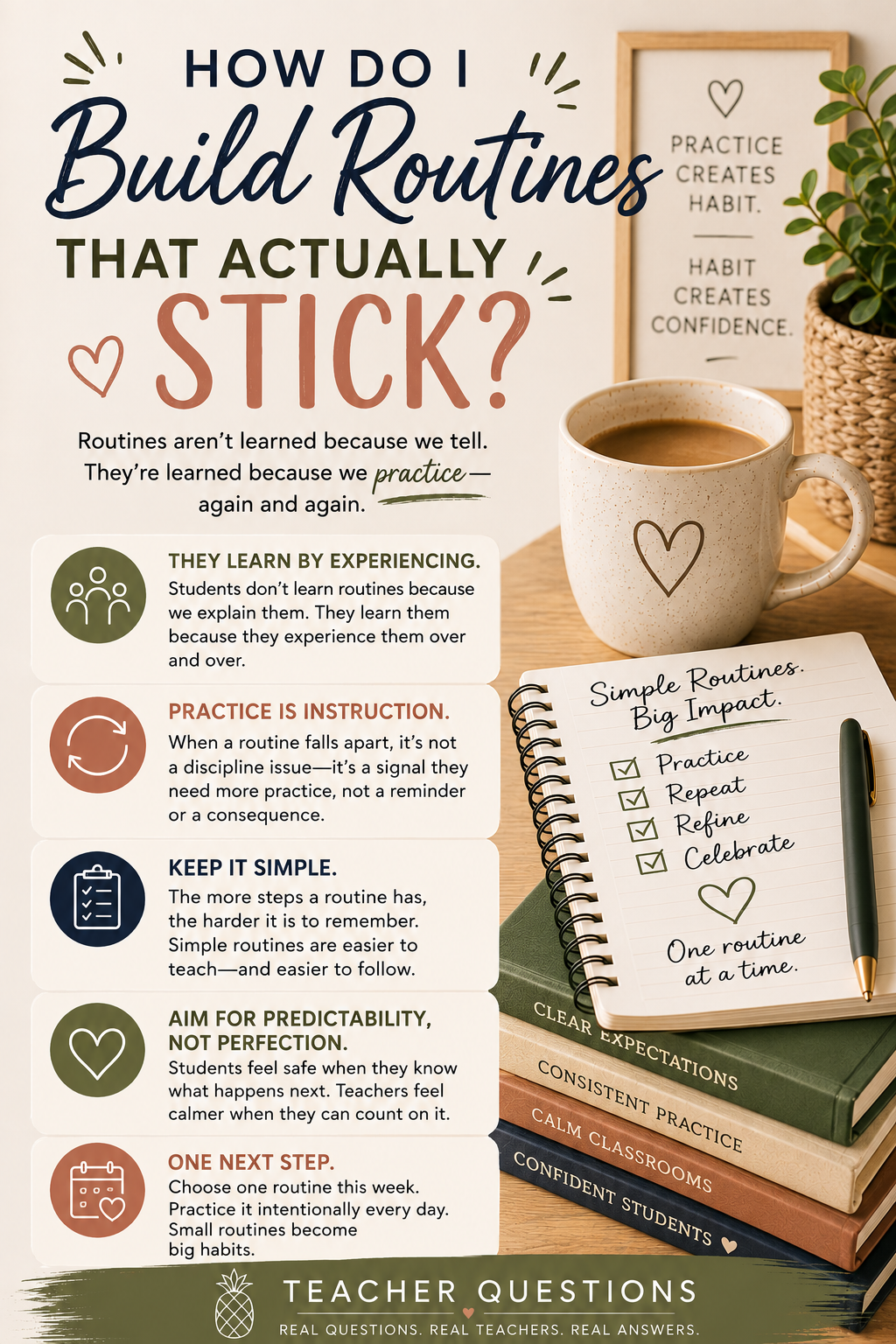
How Do I Build Routines That Actually Stick?
Strong classroom routines aren't built because we explain them well—they're built because students experience them consistently. Before you repeat the directions one more time, let's look a little closer at how routines actually become habits.
We've all been there.
You explain the routine.
You model it.
Students nod.
Everyone seems to understand.
Then the next day...
It's like you've never talked about it before.
For a long time, I assumed that meant I hadn't explained it well enough.
So I'd explain it again.
Longer this time.
Then I'd answer more questions.
Then I'd remind everyone again the next day.
Before I knew it, I was spending more time talking about routines than students were actually practicing them.
Looking back, I don't think my students needed another explanation.
They needed another experience.
Before We Jump to Solutions, Let's Look a Little Closer
When a routine falls apart, it's easy to think,
"They know this."Sometimes they do.
Sometimes they're still learning.
As teachers, we instinctively reteach academics.
If students struggle with regrouping, we don't assume they'll never understand math.
We practice.
We model.
We give them another opportunity.
But when routines fall apart, we often expect understanding after one explanation.
The truth is, routines are learned the same way reading, writing, and math are learned.
Through repetition.
Through practice.
Through mistakes.
Through trying again.
Learning to Drive
I think about learning to drive.
Someone could explain every traffic law perfectly.
You could memorize every road sign.
You could ace the written test.
But you wouldn't become a confident driver by listening.
You become a driver by sitting behind the wheel.
By practicing.
By making mistakes.
By trying again the next day.
Classroom routines work the same way.
Students don't become confident because we explained the procedure beautifully.
They become confident because they've experienced it so many times that they no longer have to think about it.
That's when a routine becomes a habit.
What I'd Look For
When a routine isn't working, I don't immediately ask,
"Why aren't they listening?"I ask different questions.
Have they practiced this enough?
Is the routine simple enough to remember?
Am I expecting independence before confidence?
Have we only talked about it, or have we actually practiced it?
Those questions usually lead me to a much more helpful answer than assuming students just aren't trying.
Practice Isn't Punishment
One of the biggest mindset shifts I made was realizing that practicing a routine isn't a consequence.
It's instruction.
Sometimes that means stopping halfway through a transition and saying,
"Let's try that one more time."Not because students are in trouble.
Because we're still learning.
That changes the entire tone of the classroom.
Students aren't being corrected.
They're being taught.
And teaching is what we're here to do.
Simplicity Creates Success
Another lesson I learned was that complicated routines are difficult to remember.
If every transition has six different steps...
Students will probably remember three.
If expectations are crystal clear...
Students have a much better chance of being successful.
Simple doesn't mean lowering expectations.
It means removing unnecessary confusion.
The fewer things students have to remember, the more likely they are to do them consistently.
The Goal Isn't Perfection
I've never had a class that followed every routine perfectly.
Not once.
Students are human.
Some days they're excited.
Some days they're distracted.
Some days they need another reminder.
That's normal.
The goal isn't perfect compliance.
The goal is predictability.
When students know what happens next, they feel more confident.
When teachers know what happens next, they feel calmer too.
Routines don't just create order.
They create safety.
Pause & Reflect
Think about one routine that frustrates you.
Now ask yourself,
Have my students had enough opportunities to practice it successfully?Or have I mostly explained it?
The answer might change what you do tomorrow.
One Next Step
Choose one routine this week.
Just one.
Don't redesign your classroom.
Don't introduce five new expectations.
Pick one routine that feels important.
Practice it intentionally every day.
Celebrate small improvements.
Give students another chance when they need it.
Small routines become big habits.
And those habits quietly become the foundation of a calm, confident classroom.
Next Questions You Might Be Asking...
→ What Makes Classroom Management Actually Work?
Discover why strong classroom management is built on relationships, routines, clarity, and curiosity.
→ Why Doesn't My Classroom Feel Under Control?
When your classroom feels chaotic, the behavior you notice may not be where the story begins.
→ Why Won't My Students Stop Talking?
Talking isn't always the problem. Sometimes it's a clue that students are waiting, confused, or unsure what comes next.
→ What's Really Behind This Student's Behavior?
Before deciding how to respond, let's look a little closer. Every behavior gives us information if we know what to look for.
→ How Can I Make Teaching Feel Less Overwhelming? (coming soon)
When everything feels urgent, learn why shrinking your timeline can help you find your footing again.